Design Principles

Design Principles

  • Design & Arts
Prioritizing Web Usability – “Affordance” is whatever can be done to an object. –

“Affordance” was originally a psychology term used to define the possible actions between a person or animal and the world. Our colleague Donald A. Norman applied the term to the user-experience world in his classic book The Design of Everyday Things. Basically, in design an “affordance” is whatever can be done to an object.

Source: Prioritizing Web Usability (Book) by Jakob Nielsen Hoa Loranger

  • Design History
  • Design Principles
  • UX Design
Click to rate
1 Star2 Stars3 Stars4 Stars5 Stars
Loading...

The impression, and not just the first one, is largely formed at the entry point, physical or attentional, to a system or environment. People do judge books by their covers and Internet sites by their first pages.

William Lidwell
William Lidwell

The Director of Design at Stuff Creators Design in Houston and author of the best-selling design book, Universal Principles of Design.

  • Design & Arts
  • Design Principles
  • UX Design
Click to rate
1 Star2 Stars3 Stars4 Stars5 Stars
Loading...
David Carson Design Unique

Never mistake legibility for communication. Just because something is legible doesn’t mean it communicates. More importantly, it doesn’t mean it communicates the right thing.

David Carson
David Carson

An American graphic designer and surfer, best known for his innovative magazine design (Ray Gun), and use of experimental typography.

  • Design & Arts
  • Communication
  • Design Principles
  • Legibility
  • Typography
Click to rate
1 Star2 Stars3 Stars4 Stars5 Stars
Loading...

People do judge books by their covers, Internet sites by their first pages, and buildings by their lobbies.

William Lidwell
William Lidwell

The Director of Design at Stuff Creators Design in Houston and author of the best-selling design book, Universal Principles of Design.

  • Design & Arts
  • Design Principles
  • UX Design
Click to rate
1 Star2 Stars3 Stars4 Stars5 Stars
Loading...
  • Design & Arts
The cost-benefit principle in UX Design

The quality of every design aspect can be measured using the cost-benefit principle

If the costs associated with interacting with a design outweigh the benefits, the design is poor. If the benefits outweigh the costs, the design is good.

For example: How long is too long for a person to wait for a web-page to load? The answer to this question is that it depends on the benefit of the interaction.

Source: Universal Principles of Design (Book) by William Lidwell Kritina Holden

  • Design Principles
  • UX Design
Click to rate
1 Star2 Stars3 Stars4 Stars5 Stars
Loading...
  • Design & Arts
People do judge books by their covers

People do judge books by their covers, Internet sites by their first pages, and buildings by their lobbies.

The initial impression of a system or environment greatly influences subsequent perceptions and attitudes, which then affects the quality of following interactions between the user and our system.

Source: Universal Principles of Design (Book) by William Lidwell Kritina Holden

  • Design Principles
  • UX Design
Click to rate
1 Star2 Stars3 Stars4 Stars5 Stars
Loading...
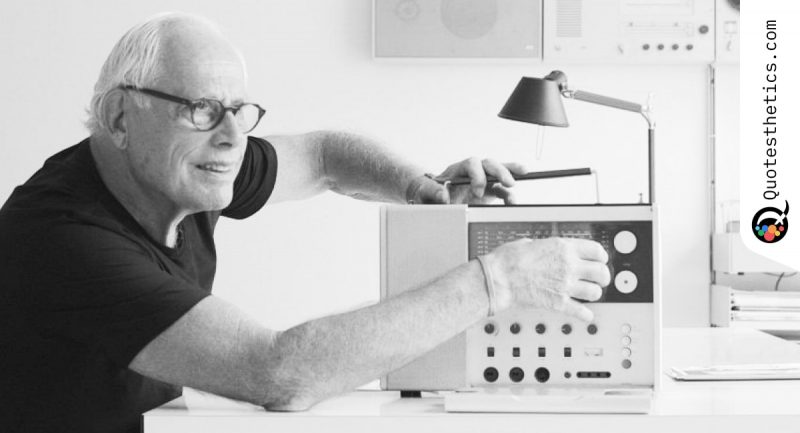
Dieter Rams on Product Design

A product is bought to be used. It has to satisfy certain criteria, not only functional, but also psychological and aesthetic. Good design emphasizes the usefulness of a product whilst disregarding anything that could possibly detract from it.

Dieter Rams
Dieter Rams

A German industrial designer closely associated with functionalist school of industrial design.

  • Design & Arts
  • Design Principles
  • Industrial Design
Click to rate
1 Star2 Stars3 Stars4 Stars5 Stars
Loading...

That a user should not be kept waiting unnecessarily is an obvious and humane design principle. It is also humane not to hurry a user; the more general principle is: Users should set the pace of an interaction.

Jef Raskin
Jef Raskin

An American human–computer interface expert best known for conceiving and starting the Macintosh project at Apple in the late 1970s.

  • Design & Arts
  • Design Principles
  • UX Design
Click to rate
1 Star2 Stars3 Stars4 Stars5 Stars
Loading...
  • Design & Arts
Design Principles – Constrains simplify usability and minimize errors

Use constraints to improve the clarity, usability and intuitiveness of your design

Constrains, as methods of limiting the actions that can be performed on a system, simplify usability and minimize errors. For example, dimming or hiding options that are not available at a particular time effectively constrains the options that can be selected.

Proper application of constraints in this fashion makes designs easier to use and dramatically reduces the probability of error during interaction. Simply put; constrains simplify usability and minimize errors!

Source: Universal Principles of Design (Book) by William Lidwell Kritina Holden

  • Design Principles
  • UX Design
Click to rate
1 Star2 Stars3 Stars4 Stars5 Stars
Loading...
Derek Birdsall White Space

Society has not improved the landscape by overfilling it with construction. Neither does a designer improved a page by overfilling it with content.

Alex White
Alex White

A cofounder of the MillerWhite School of Design and Chairman of the Type Directors Club.

  • Design & Arts
  • Design Principles
  • Space
  • White Space
Click to rate
1 Star2 Stars3 Stars4 Stars5 Stars
Loading...